Carolina Custom Models · HO Scale
Talgo
Series VI
HO Scale Trainset
Fully reserved · Waitlist open
All 25 sets reservedWaitlist open
A complete 13-car Talgo Series VI set in HO scale, assembled and unpainted, with an interior in every passenger car and a functional rodal at every joint. Reserving a place in the first production run is free and commits you to nothing.

The consist
Thirteen cars, Power to Baggage.
The full Series VI set, from the Power car’s batwing end to the Baggage car. Every joint rides on a functional rodal, the shared wheel unit between cars that makes a Talgo a Talgo.
- Power7900
- Business7450
- Accessible Business7550
- Dining7800
- Bistro7300
- Accessible Coach7500
- Coach7400
- Coach7425
- Coach7402
- Coach7403
- Coach7404
- Coach7401
- Baggage7100
Swipe to see the whole train →
13
Cars in the set
12
Articulated joints
1:87.1
HO scale
The set
Every car, finely detailed.
Each passenger car gets its own interior insert, from the Business class seating to the Bistro counter. Here’s a first look, straight from the production CAD files.
Set includes
- Complete 13-car Talgo Series VI set
- Resin-printed shells on PETG chassis
- Interior inserts in all 11 passenger cars
- Functional rodals
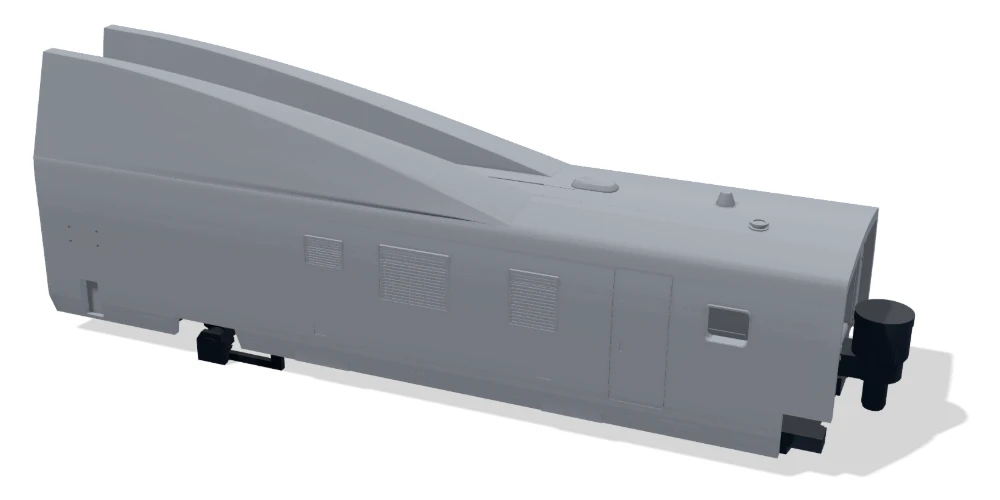
Power car
7900
The batwing end, with roof fittings, louvres and a socket for the end-light board. Drilled for brass grab irons, with room inside for the decoder and speaker.
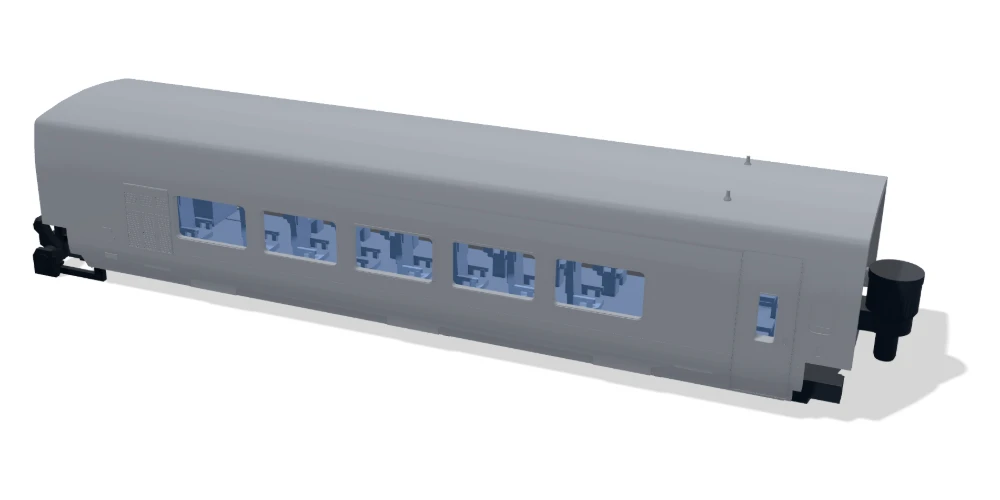
Business class
7450
26 seats, mostly in a wider 2+1 layout.
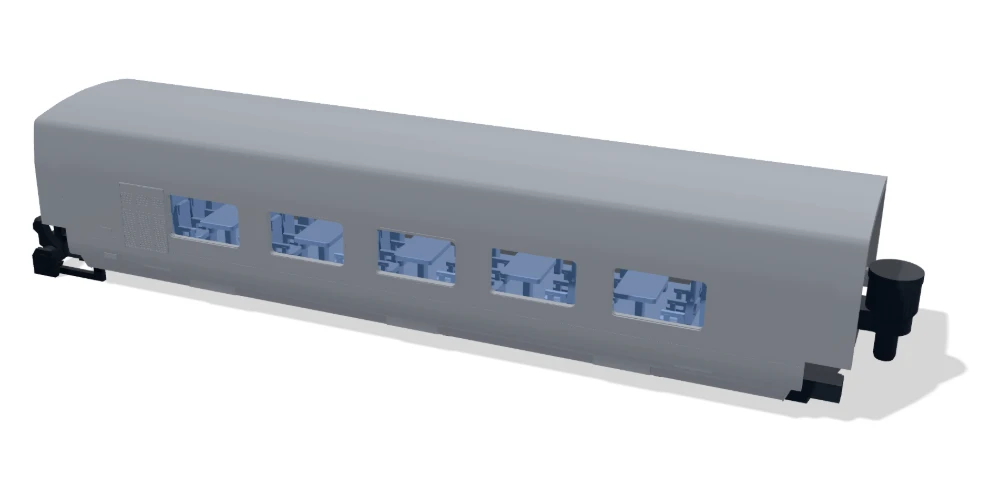
Dining car
7800
30 places at padded booths, with diamond divider screens.
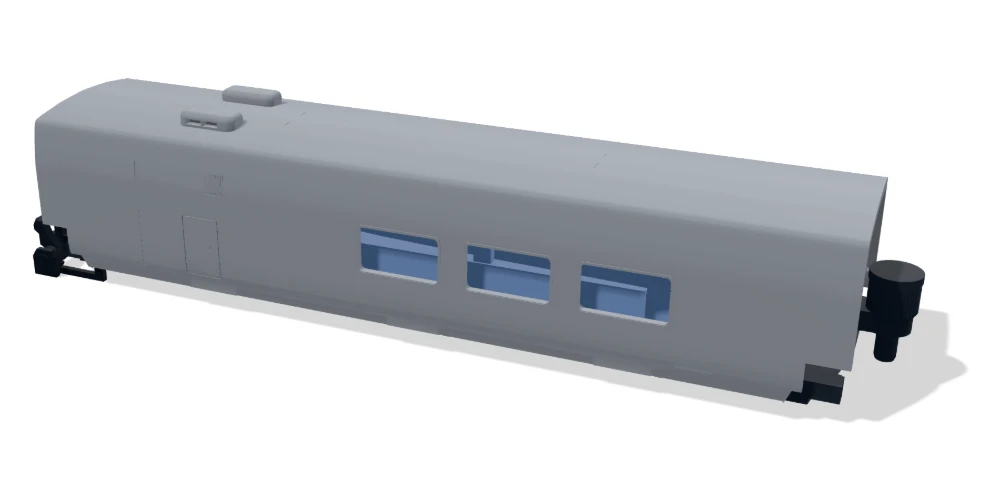
Bistro
7300
A sweeping counter and seven bar seats under a Pacific Northwest ceiling map.
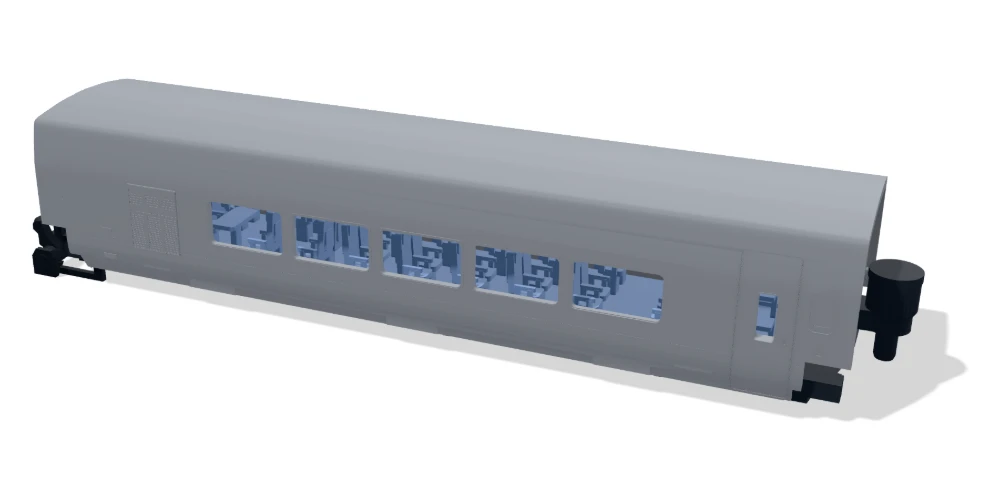
Coach
×6
Six in the set. 36 seats each, with headrests, armrests and tables.
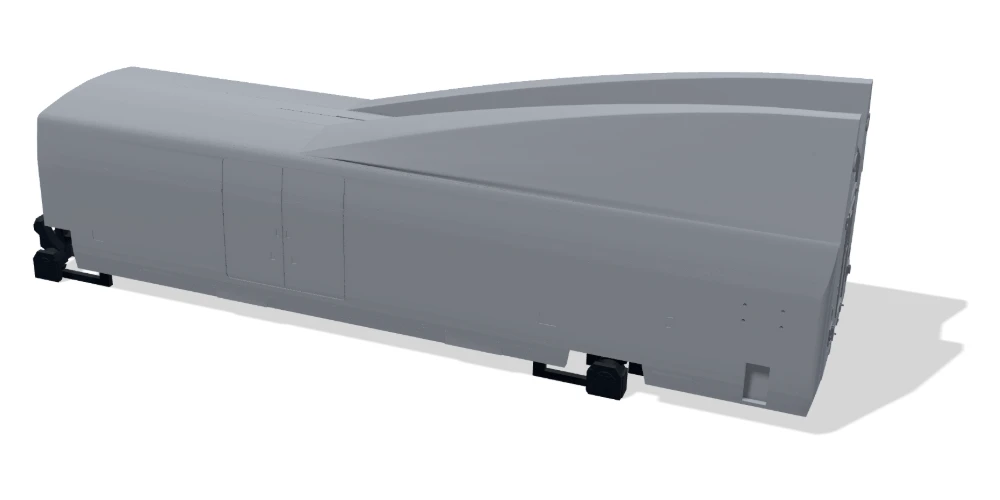
Baggage car
7100
Wide baggage doors and the second end-light socket. Drilled for brass grab irons, with room inside for a decoder.
Renders from the production CAD files. The cars come assembled and unpainted; glazing, wheelsets and couplers are not shown.
How it goes together
Four parts to every car.
Each passenger car is built from the same four printed parts. The interior sits on the floor, the shell lowers over both, and the cars articulate on shared rodals between them.
- Shell — resin-printed, with the windows, doors and end details
- Interior — one resin-printed piece per passenger car, seats to luggage racks
- Floor — the chassis that carries the joints, filament-printed in PETG
- Rodal — the shared wheel unit under each joint
Resin gives the shells and interiors their fine detail. The chassis takes the load, so it’s printed in PETG, a tough filament that stands up to heat: it holds its shape to about 70 °C (158 °F) and doesn’t soften until around 80 °C (176 °F), some 20 °C higher than PLA, the most common printing plastic. The frame stays straight and the joints stay true in a warm layout room.
 ShellResin
InteriorResin, one piece
FloorPETG chassis
RodalShared wheel unit
A look inside
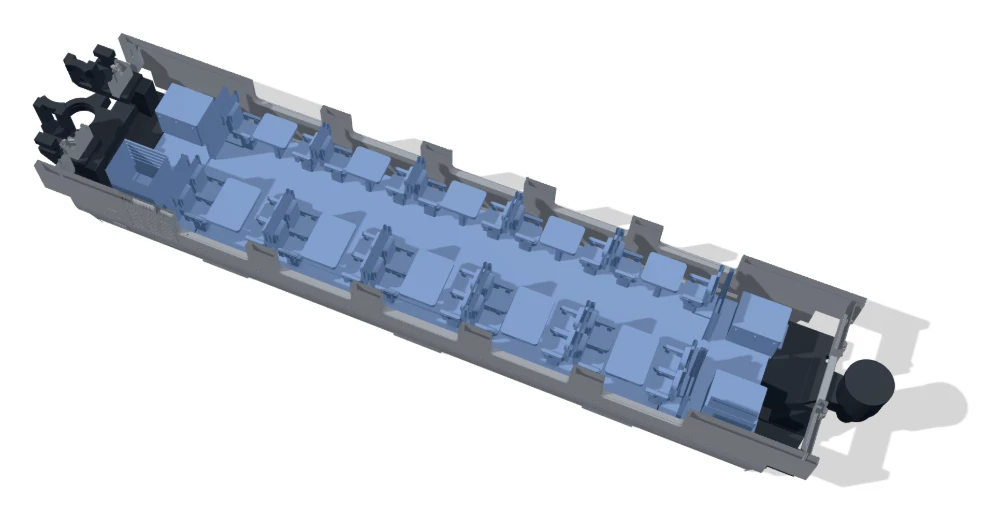
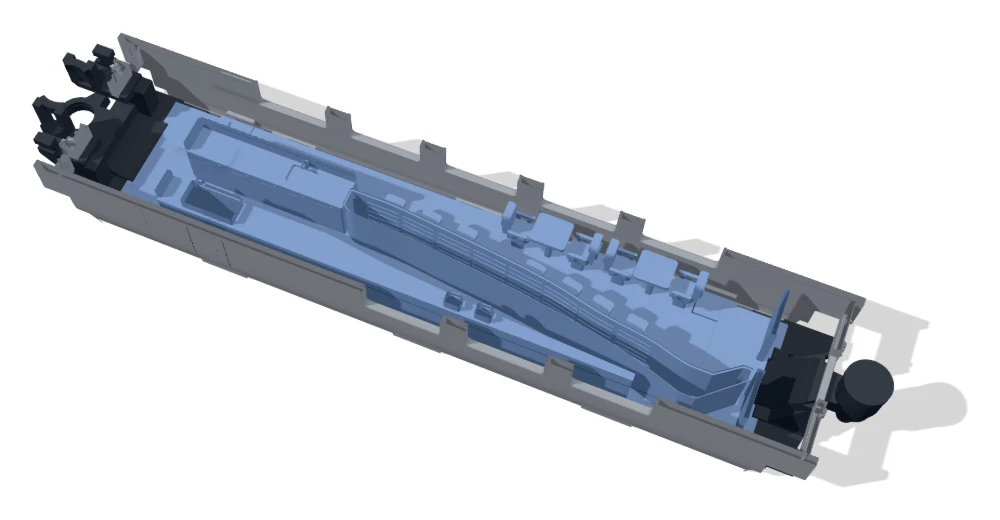
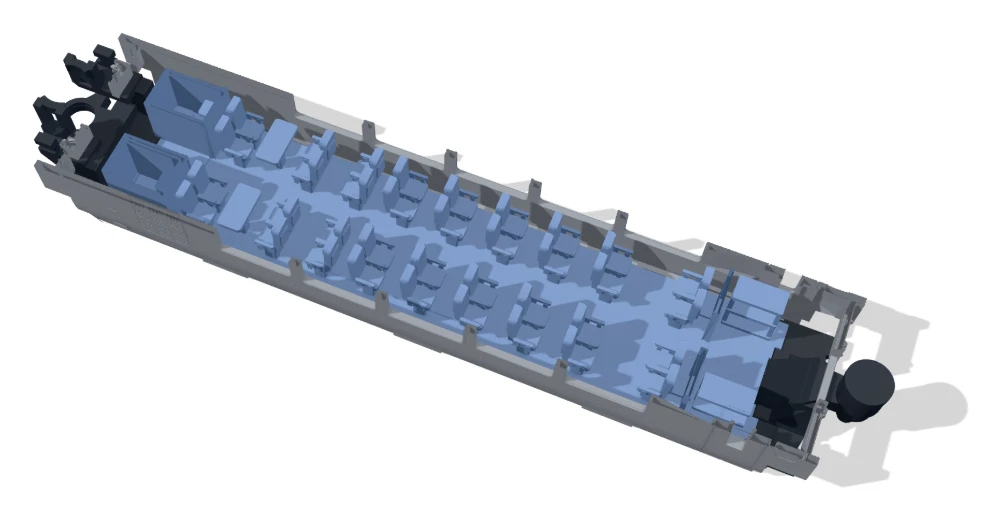
Each car shown sectioned just above the seat backs, so you can see the interior in place.
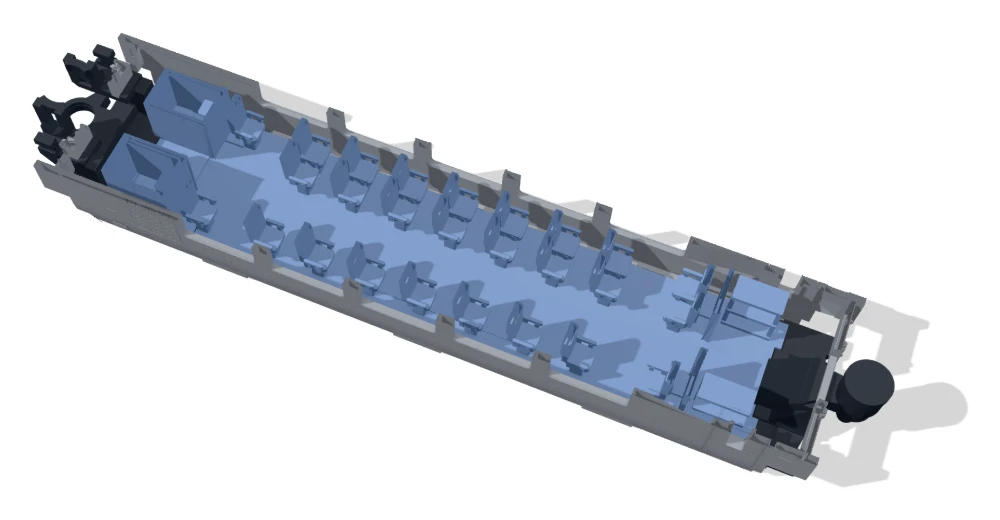
Business class
7450
26 seats, mostly in a wider 2+1 layout.
Dining car
7800
Padded booths with diamond divider screens.
Bistro
7300
The sweeping counter and its seven bar seats.
Coach
7400
36 seats with headrests, armrests and tables.
Lights and power
Lit ends and interiors. Power through every joint.
Three systems are designed into the Series VI: working end lights on a slide-in circuit board, lit interiors in every passenger car, and track power shared along the whole train through its articulated joints.
 Marker lightsRed
End-light boardSlides up into the shell
Ditch lightsWhite
Slide-in end-light board
A slim circuit board slides up into a socket moulded into the end of the Power and Baggage shells. It carries two white ditch lights and two red markers, with the left ditch light, right ditch light and markers on separate decoder functions. The boards come with the Lighted version.
 Markers
Ditch lights
Four wire pads
 Gold contact tracksRail A and Rail B
Rolling contactsOne for each rail
Shared rodalThe pin still carries the load
Continuous train power
Lower a car into place and two rolling spring contacts meet gold tracks on its coupling collar; lift it and they separate. There are no plugs and no wires to connect between cars. Wheel pickups on several rodals feed both rails along the whole train, so every car draws power from all of them. The contacts are an optional extra.
 Collar lifts out
Contacts stay put
In prototype testing now. On a reversing section, the joined train counts as one long pickup, so the section needs to fit the whole train.
 Light board12 warm-white LEDs, facing down
Diffuser filmsOne under each row of LEDs
InteriorCeiling and recess built in
Lit interiors
Every passenger interior has its own ceiling, with a recess that takes a slim light board, LEDs facing down. The warm-white LEDs shine down through opal diffuser films in two rows along the car. Two short wires tap the train’s power bus, so the interiors light whenever the track is powered. The boards come with the Lighted version.
 UniversalTen cars
BistroMap, crescents, downlights
Two boards light eleven cars
One board design, with twelve LEDs, fits all ten Coach, Business, accessible and Dining cars. The Bistro gets a wider board of its own with twenty: two rows for the crescent lights, six behind the ceiling map and two downlights. Both run straight from the track on DCC or DC, with no decoder to set up.
 Town lights176 Northwest towns
Crescent lightsAlong both sides
DownlightOne at each end
A Northwest map in the Bistro ceiling
Like the real Bistro cars, the model has a lit map overhead. A map of the Pacific Northwest runs down the middle of the ceiling, with 176 towns picked out in pinpoints of light, from Kamloops and Nanaimo in British Columbia to Medford and Klamath Falls in Oregon. LEDs in a chamber above shine through a pinhole at each town. Crescent lights run along both sides, with a downlight at each end of the map.
Our own map: terrain and coastline from Natural Earth (public domain), town locations from GeoNames (CC BY 4.0). The render shows the lights on; brightness and colour will be set on the first built boards.
Two versions
Lit or unlit. The same 13 cars.
Every set is the complete train, assembled and unpainted, with its rodals and painting stencils. The Lighted version adds the circuit boards for working end lights and lit interiors.
Unlighted
$799 per set, plus taxes
The complete train, ready for your paint shop.
In the box
- 13 assembled cars, unpainted
- Resin-printed shells and interiors on PETG chassis
- A rodal for every joint
- Painting stencils
Lighted
$999 per set, plus taxes
Everything in Unlighted, plus the light boards.
In the box
- 13 assembled cars, unpainted
- Resin-printed shells and interiors on PETG chassis
- A rodal for every joint
- Painting stencils
- PCB end-light boards for the Power and Baggage cars, each with two white ditch lights and two red markers
- PCB interior light boards
The boards come in the box for you to fit.
You add
- 36″ RP-25 metal wheels (14)
- Kadee couplers
- Weights
- Assembly screws
Optional extras
- Contacts for continuous train power through every joint (in prototype testing)
- ESU LokPilot 5 FX decoders, to control the end lights
- ESU LokSound 5 FX decoders, for the end lights plus head-end power (HEP) sound
Both versions come from the same first run of 25 sets, and you choose when you reserve. Reserve yours
Kadee, ESU, LokPilot and LokSound are trademarks of their respective owners. Wheels, couplers, weights, screws, contacts and decoders are not included.
Reservations
How reserving works.
A reservation holds your place in the first production run. It’s free, it isn’t a purchase, and you can release it at any time.
Reserve for free
No payment and no card details. A reservation holds your place in the first production run.
Confirm by email
We’ll send you a link. Your reservation counts once you click it.
Join the waitlist if it fills
The first run is limited. Once it’s full you can join the waitlist, and any set that frees up goes to the next person in line.
Purchase when it’s ready
When your set is ready, we’ll email you a link to complete your purchase.
Questions first? The FAQ covers confirmation, the waitlist and what happens to your details.
Join the waitlist
All reservation slots taken 2 people waiting
- Scale
- HO
- Estimated price
- $799 unlighted · $999 lighted, plus taxes
- Estimated delivery
- From December 2026, in reservation order
This run is fully reserved. Join the waitlist and we will contact you in order if a slot is released — and your spot helps us size the next production run.
Next on the workbench
What comes after the Series VI.
Two projects are well into design. Neither is taking reservations yet; here’s where each one stands.
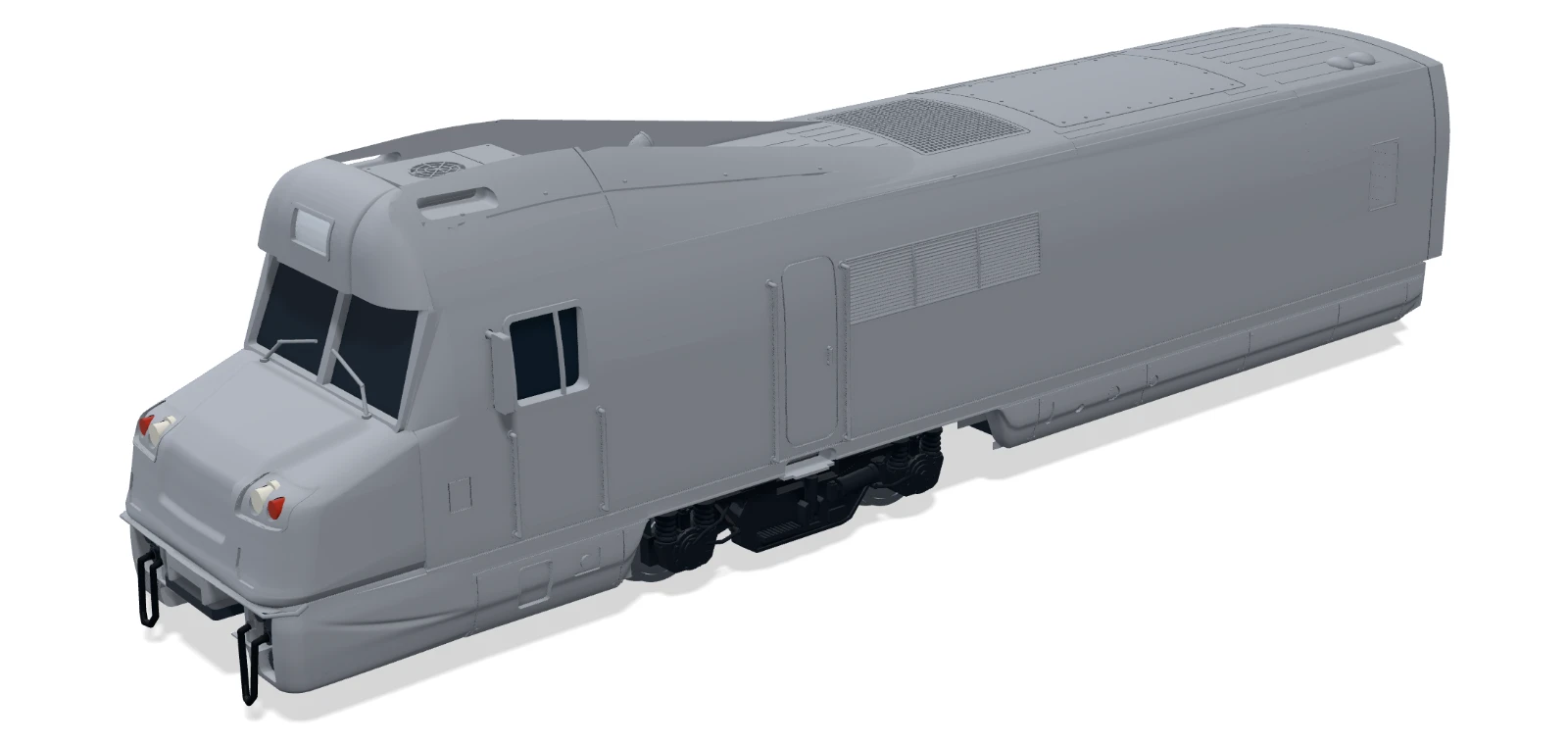
In design
Talgo Series 8
Oregon's Series 8 trainsets in HO: a 13-car set led by a detailed cab car, with every passenger car getting its own interior.
Prototype on the bench
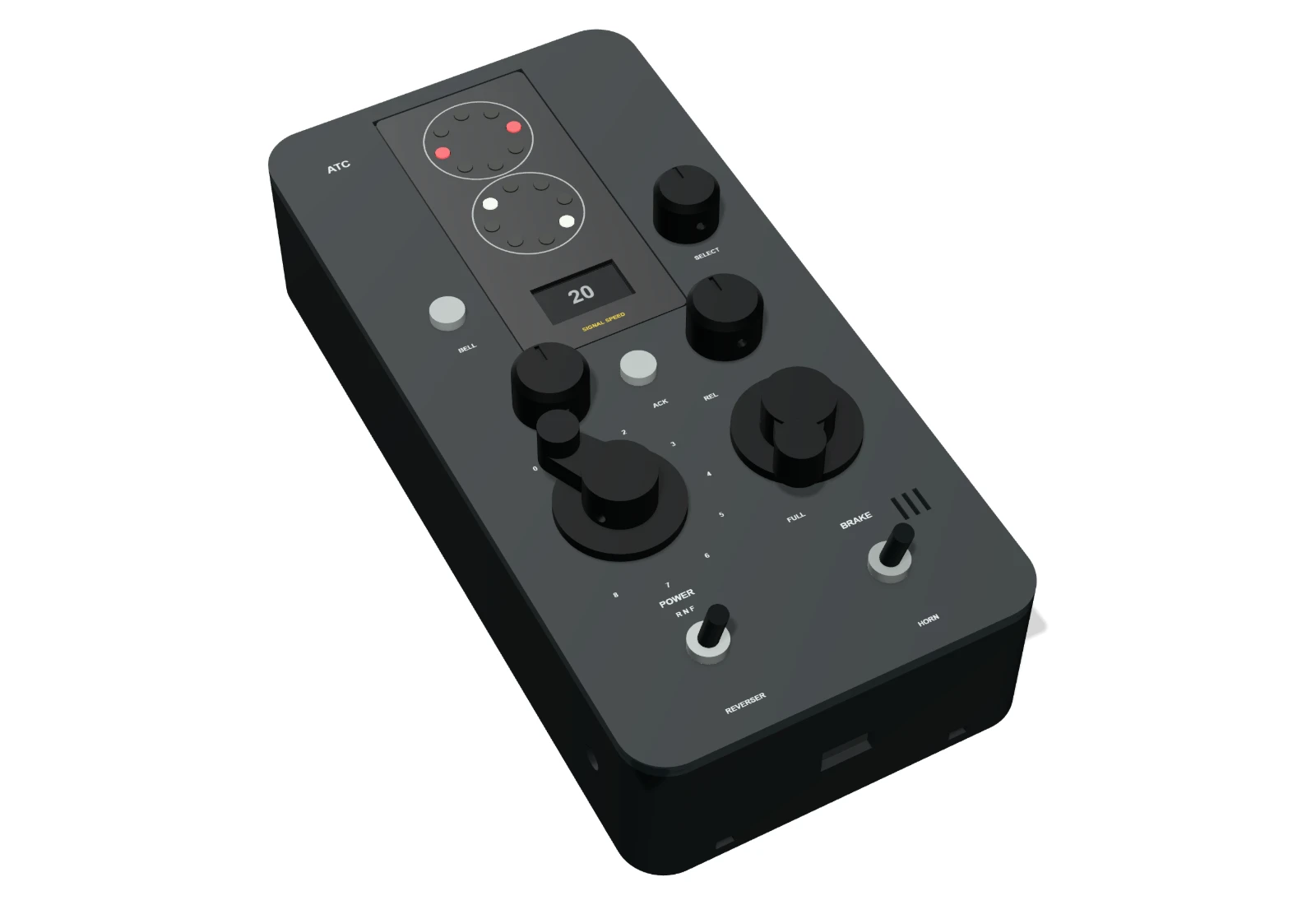
ATC Cab
Advanced Train Control in your hand: notched throttle, proportional brake and a real reverser, all 28 functions, switches and consists, and cab signals from JMRI. Built for Digitrax.
About us
Small-batch models, made in North Carolina.
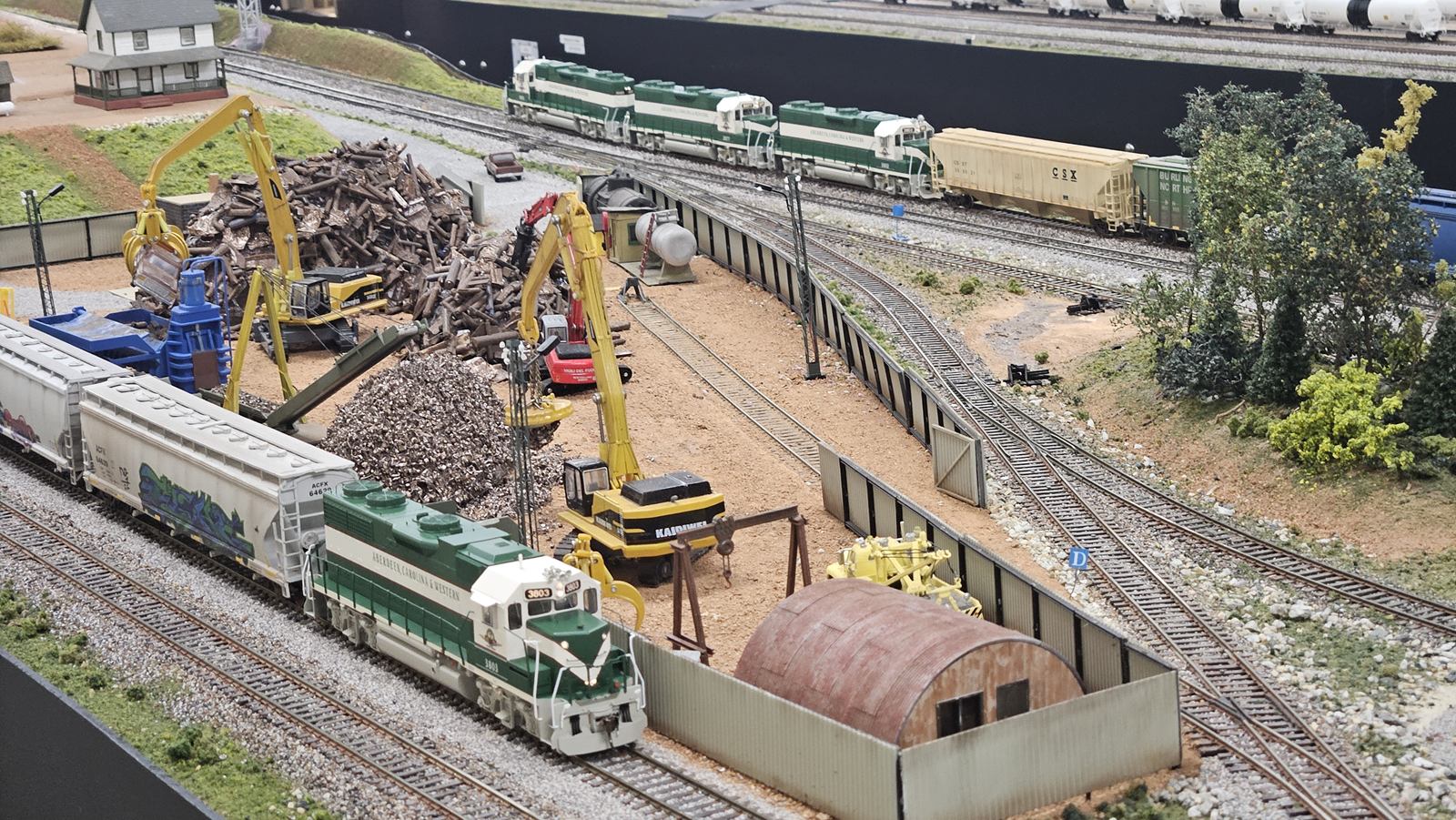
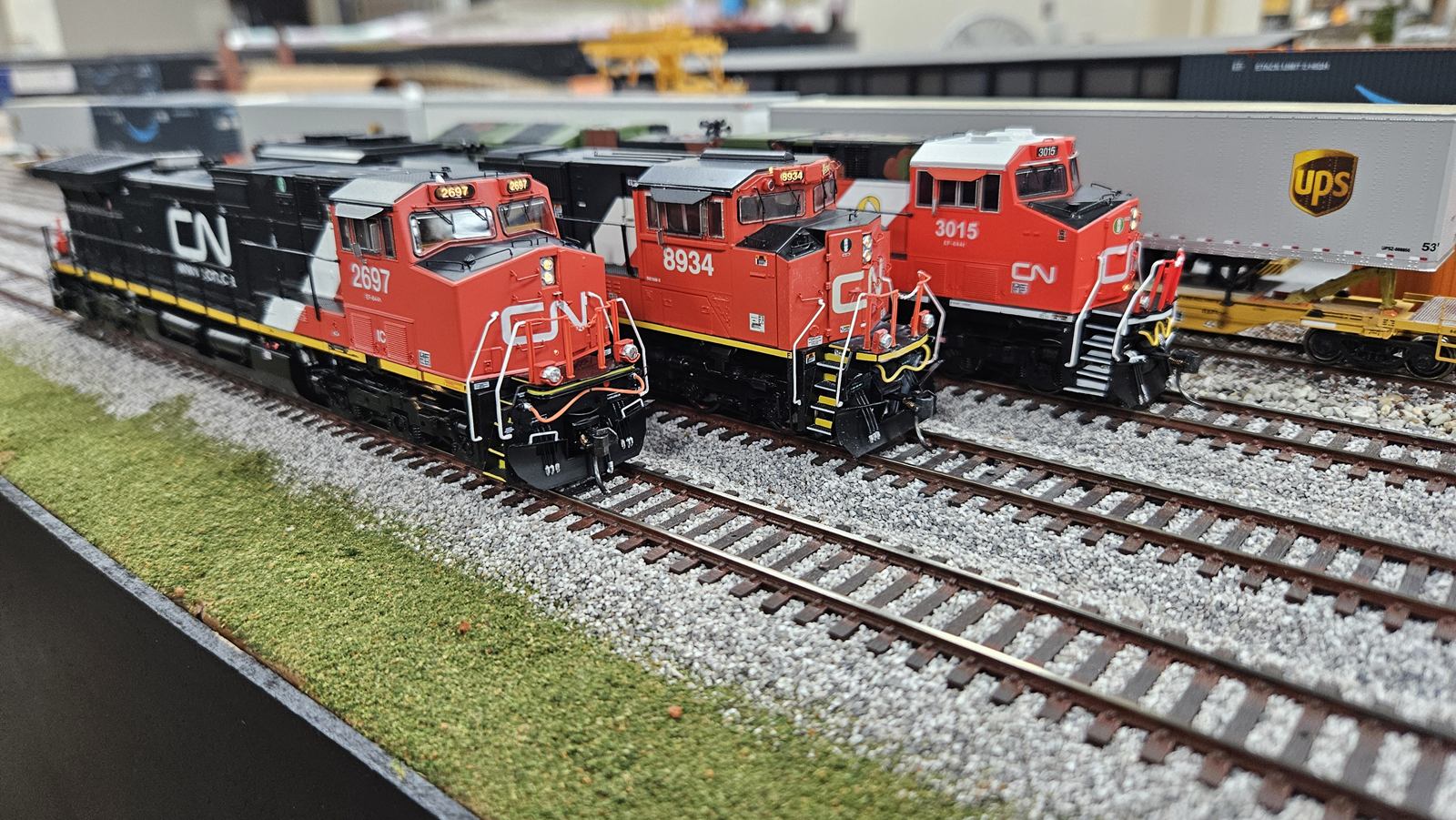
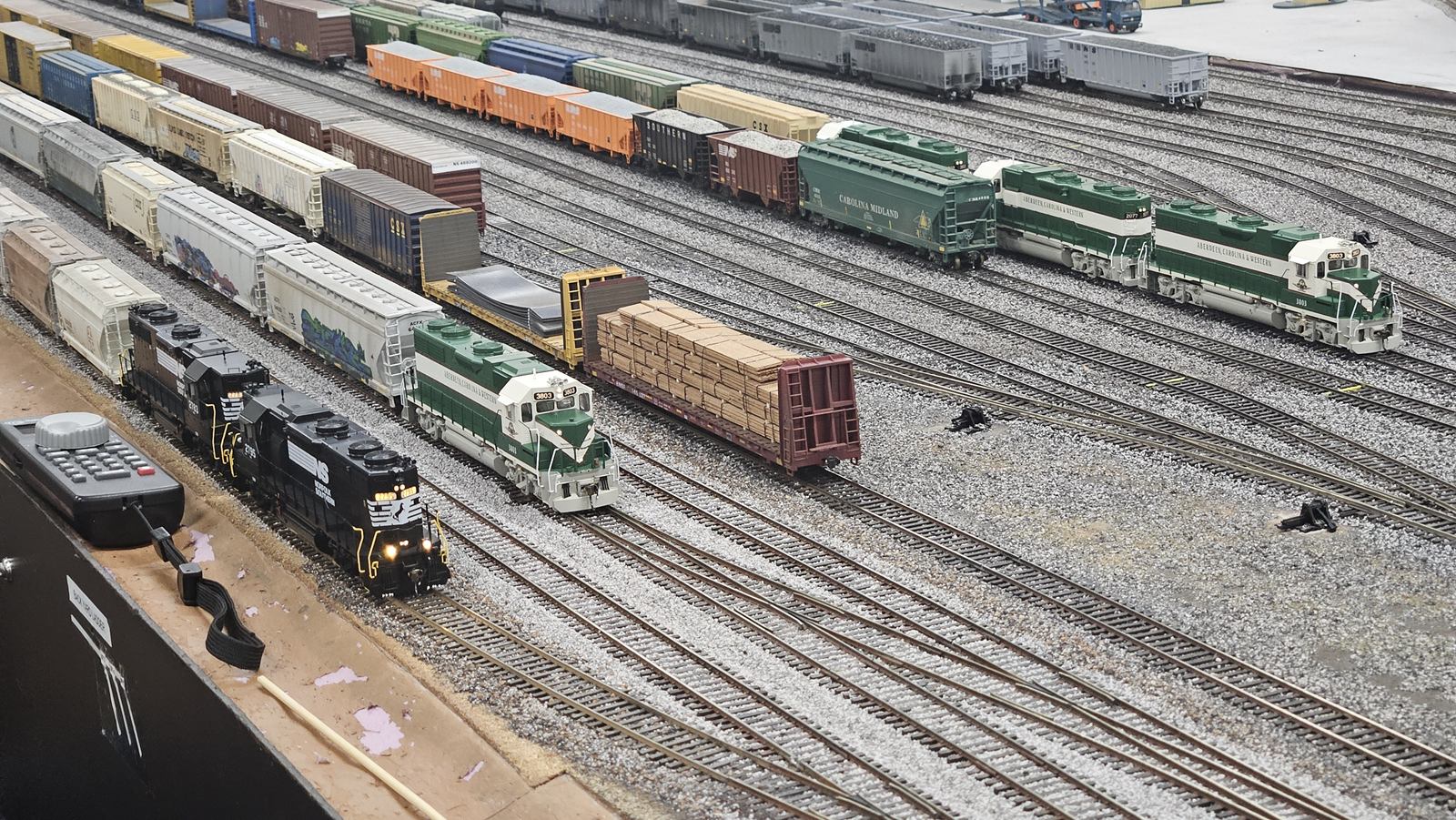
Carolina Custom Models makes high-quality 3D-printed HO scale models and custom fabrication work, with precision and detail in every model. The Talgo Series VI is next on the workbench.
Questions before you reserve?
Most answers are in the FAQ. For anything else, email support@carolinacustommodels.com.